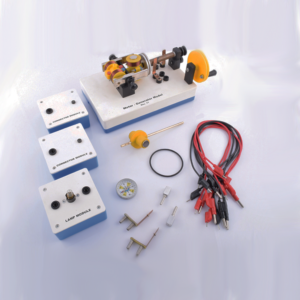
This motor-generator set gives students an insight into the physical and technical relationships on which electric motors, generators and transformers are based.
The modular system allows to set up different function models without tools: Various DC motors Series and shunt motor Synchronous motor DC generator and alternator Transformer.
This set allows the performance of 10 student experiments about the following topics:
Magnetic field of a coil
Conversion of electrical energy into kinetic energy
Commutator
Direct current motor
Synchronous motor
Series and shunt-wound motors
Electromagnetic induction
The electrical generator
Engine-generator
Transformer
A simple form of D.C. motor with 2 pole armature wound with insulated copper wire and a permanent magnetic field provided by a removable bar magnet with a commutator and phosphor bronze brushes connected to 4 mm sockets, open construction, all parts visible.
The large size of this battery operated apparatus allows students to better understand the operation of this basic circuit.
Works on 9 V Battery.
Includes Instructions.
On wooden stand.
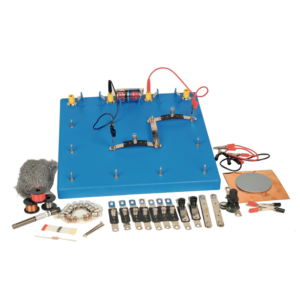
Enables students to investigate nature and properties of electricity by using simple circuits which are easily constructed on a base board.
The connector system uses P.C.B. strips with cut-out sections whose ends can easily be inserted in spring terminals, ensuring low contact resistance and ease of connection.
The kit consists of :
1. Baseboard, plastic, with spring terminals and three battery holders. (1)
2. Batteries. (3)
3. Lamps 1.25 V MES. (10)
4. Lamp holders mounted on PCB connectors. (6)
5. Plain connector PCBs. (10)
6. Wire wound potentiometer with crocodile clip connections. (1)
7. Silicon diode. (1)
8. Resistor 3.9 ohm 2.5 W (1)
9. Pair Leads, red, with crocodile clip at each end. (1)
10. Pair Leads, black, with crocodile clip at each end (1)
11. Pair Leads, yellow, with crocodile clips at each end. (1)
12. Switches mounted on PCB. connectors (2)
13. PVC rod 15 cm long (1)
14. Soft iron nails, 5 cm long (2)
15. Bare copper wire, swg 20 (2 m)
16. Bare eureka wire, swg 34 (2 m)
17. Plastic covered copper wire (2 m)
18. Electrode support (1)
19. Pencil lead electrodes (10)
20. Sheet copper foil, 150 mm square (1)
21. Pack Steel wool (1)
22. Instruction manual in English. (1)
Students can explore how a simple electric motor works by doing a series of investigations.
This St. Louis motor can be adjusted so students can study the effect of voltage and position of the brushes on the commutator.
The motor consists of a two pole DC armature. The brush holder, with two heavy binding post terminals, can be rotated for experiments.
The permanent bar magnets, supported by clamps, can be adjusted to the desired location.
This apparatus requires 4 D cell batteries with holder (not included) or a power supply and two connecting leads (not included).
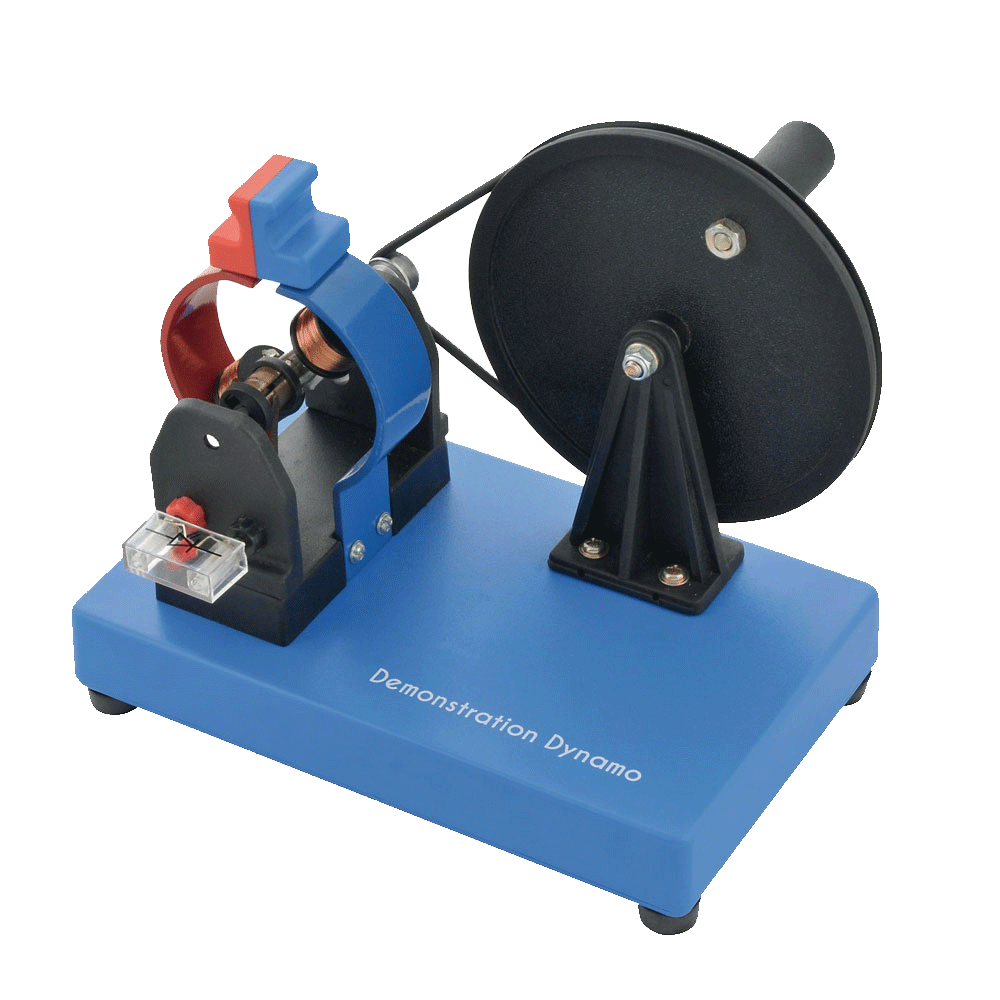
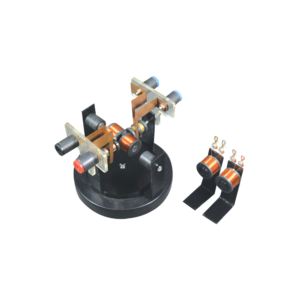
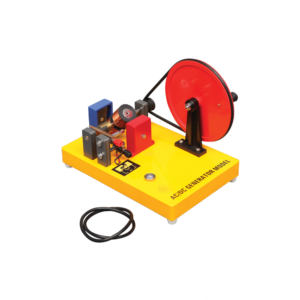
Generates both AC and DC.
When the two brushes of the generator are put in the two ends of the commutator, the output is an AC.
When the brushes are put in the middle of the commutator, the output is a DC.
Includes Instructions.




















Reviews
There are no reviews yet.