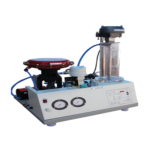
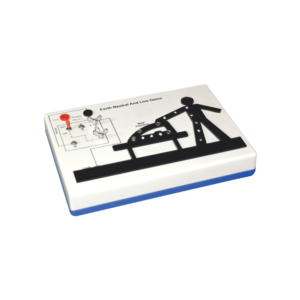
This apparatus is an effective demonstration of how the earth wire and fuse act together to protect both the user and the appliance.
When the appliance is connected correctly and the LEDs in the appliance will illuminate to show the appliance is working.
A fault is then demonstrated by swapping the live wire from inside the appliance to the case to show either the fuse melts (protecting the user and appliance) or in the case of no earth wire, the LEDs illuminate to indicate the passage of current through the person to ground.
The fuse is easily visible and can be seen to ‘blow’ when a fault occurs.The unit is supplied with 10 m of fuse wire and full instructions.
A 12 V DC power supply is required.
Connections are made via 4 mm shrouded sockets.
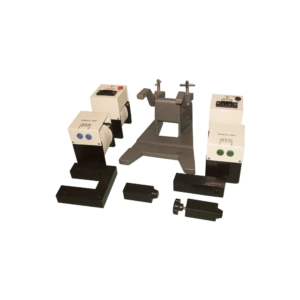
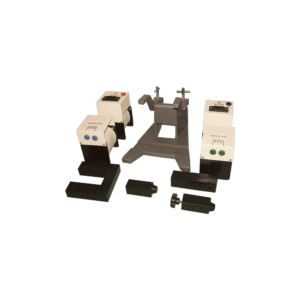
Apparatus is designed primarily for demonstration of the basic principles of transformers.
It consists of a laminated U-core with laminated I-core, both with 32 x 25 mm cross section to form a closed core of size 102 x 127 mm.
Heavy aluminium alloy stand with removable clamping rods, 2 pole pieces, each 65 x 30 x 25 mm with one end cone shaped, to accept support rod and shading ring.
Poles also have a hole drilled through lengthwise to take a light beam. 300 turns 600 turns 1200 turns 3600 turns 12000 turns
Students can explore how a simple electric motor works by doing a series of investigations.
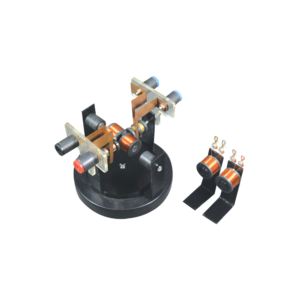
This St. Louis motor can be adjusted so students can study the effect of voltage and position of the brushes on the commutator.
The motor consists of a two pole DC armature. The brush holder, with two heavy binding post terminals, can be rotated for experiments.
The permanent bar magnets, supported by clamps, can be adjusted to the desired location.
This apparatus requires 4 D cell batteries with holder (not included) or a power supply and two connecting leads (not included).
To demonstrate the characteristics of simple and primary cells.
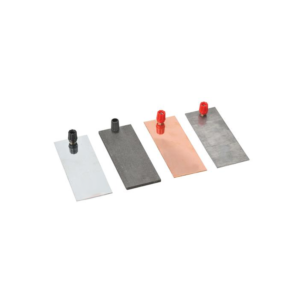
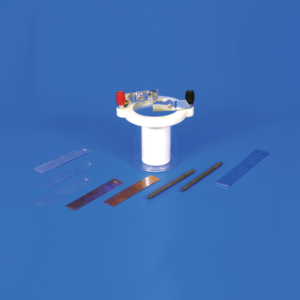
Consists of a plastic jar with a screw-on plastic rim containing two adjustable brass electrode holders, eight electrodes of different metals and a porous ceramic cup.
With Instructions.
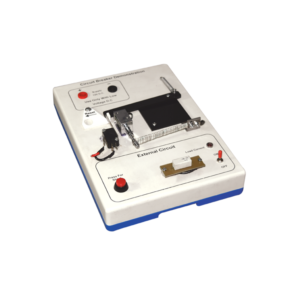
Investigate the working principle of circuit breaker type fuse with this demonstration model.
The apparatus is built on a robust plastic base and includes resistive loads to simulate external wiring circuits.
Applications of the thermal response of bimetal strips and also electromagnetism (movement from a solenoid) are clearly demonstrated in this model.
When a 12 V DC supply is connected (not supplied) the LED lights to show that current is flowing in the external circuit and the bi-metal strip can be seen to bend as its heater coil raises the temperature.
After a few minutes the bending is sufficient to trip the mechanism and the current path is broken.
At any current selection a short circuit situation can be initiated by pressing the red button and this produces an immediate response from the solenoid to disconnect the supply.





















Reviews
There are no reviews yet.