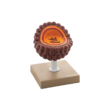
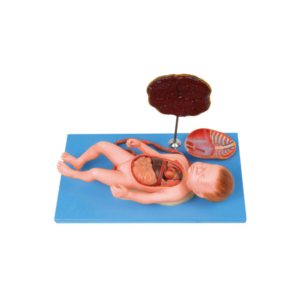
Placenta, umbilical cord, abdominal cover, lungs, heart, thymus, diaphragm, liver, stomach, intestine, body.
Shows a female fetus at the end the pregnancy with placenta and umbilical cord.
Made of Advanced PVC.
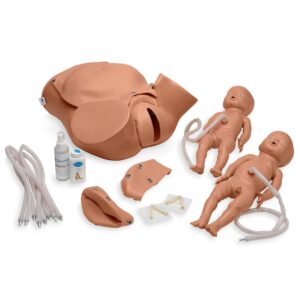
The model basing on the mechanism of normal labor shows the cardinal movements of engagement.
Descent-flection-internal rotation of the head-extension-retitution-external rotation of the head-internal rotation of the shoulders at accouchement.
Suitable for teaching the mechanism of normal labor in medical colleges and nursing schools.
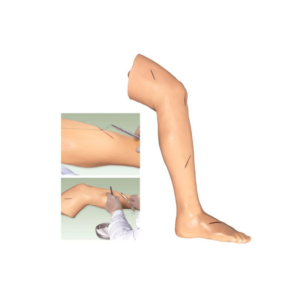
This model of Advanced Surgical Suturing Leg allows the students to practice cut, suturing, stitches release, enswathing, etc.
The elasticity and flexibility of skin can make it for practice hundreds of times.
There are some initial wounds on the arm and if all the initial wounds have been sutured, people can cut the arm in other place for new training of suturing.
Catheterization Trainer Simulator trainer, male bladder catheterization procedures can be realistically demonstrated, practiced and assessed.
The genital inserts are placed into the anatomically correct lower abdominal model and held in place with magnets.
The material is soft and flexible:
the foreskin is movable and the penis can be stretched.
This way the student can practice all the necessary gestures for catheterization (e.g. disinfection).
The material gives a realistic feeling when inserting and removing the catheter into the bladder with realistic resistance and insertion depths.
Direct learning:
When the catheter has been correctly inserted, fluid runs out, just like with a real patient. The catheter can also be checked through the transparent bladder. The abdominal wall can be removed so that the process can be viewed better.
Various levels of difficulty:
On the male insert, three different levels of prostate narrowing can be set.
In the narrowest case, the student can feel that catheterization is no longer possible through the urethra and that a suprapubic catheter will have to be inserted.
A suprapubic catheter has already been put in place and the student can practice cleaning it and taking care of it with the trainer.
All the benefits of the male catheterization simulator at a glance:
Male catheterization with realistic resistance
3 levels of adjustable prostate narrowing soft and movable foreskin (for practicing disinfection, for example)
Anatomically realistic pelvic structure
Liquid outflow if catheterization is successfully carried out
The transparent bladder can be checked and the abdominal wall can be removed
Includes suprapubic catheter for practicing, cleaning and caring for it.
Stands securely on the table thanks to the non-slip feet
Magnetic connectors for quick set-up and dismantling
Easy to clean and maintain, and can be completely taken apart
A sponge on the inside prevents a build-up of moisture.
Suturing Simulators provide a realistic way for students to learn good surgical techniques.
The simulators provide students with a variety of repair experiences without the constraint of time and concern for safety, which are factors with a live patient.
The simulators can be used by the student in a learning lab with an instructor or by the student individually in the clinical setting just prior to a patient experience.
They are also useful as homework teaching aids that can be signed out at night and returned the next day.
In addition to being portable, the lifelike texture allows the learner to develop a “feel” for instrument handling, tension on suture, and the advantages of one method of tying knots over another.
Includes one of each simulator:
Midline Suture Simulator
Left Mediolateral Suture Simulator
Right Mediolateral Suture Simulator
Each simulator comes with an instruction booklet and is individually boxed.
For Continuous Ambulatory Peritoneal Dialysis.
Designed to introduce patients, students, and nurses to the essentials of CAPD procedures and care.
The realistic torso offers a realistic method to demonstrate and practice peritoneal dialysis.
Success with CAPD is dependent on the patient’s following dialysis procedures with extreme care.
This Life/form simulator gives the patient an opportunity to gain the confidence necessary for prolonged success with CAPD.
Complete with indwelling Tenckh off catheter in a hard carry case.
Dialysis materials not included.
Interchangeable arterial and venous inserts within the fore arm allow creation of arteriovenous (AV) fistulas and placement of AV grafts, while a simulated healed fistula insert provides a platform on which hemodialysis exercises can be performed.
An additional multi-layer insert in the bicep area can be used for incision and suture training exercises.
Advanced Arterial Patient Training Arm Features:
Subcutaneous injection sites on the volar forearm and lateral upper arm
Intra Muscular injection site on the upper arm
Arterial system including the radial and brachial arteries
Suture and incision sites on both the upper arm and forearm
Hem dialysis site on the forearm
Arterial and Venous insert for IV and blood draw exercises, AV anastomosis, and placement of AV grafts. This multi-layer surgical insert includes the skin, subcutaneous tissue, muscle, radial artery, and radial vein
AV fistula insert that simulates a healed fistula for hem dialysis exercises.
Multi-layer bicep insert that includes the skin, subcutaneous tissue, and muscle and allows incision and suturing exercises
Durable skin that can be pierced in excess of 200 times with a 20 or 22 gauge needle
Realistic tactile feedback for both surgical and arterial & venous stick exercises
Adjustable heart rate and pulse strength simulating a heart rate from 10 BPM to 150BPM
Cephalic (antecubital), Basilic, Radial, and Ulnar veins as well as the radial and brachial arteries for infusion and blood draw.
Rotating arm allowing dorsal and volar access along the length of the arm.
Varying vessel palpability to simulate collapsed or bulging vessels and ease of assembly.
Latex-Free
New proprietary materials replicate of skin, subcutaneous, and muscle layers at all surgical sites.
Upgraded inserts, skins, and vessels for improved tactile feedback
Micro pump embedded within the shoulder generates variable heart rates and pulse strength.
Easy to replace plug-and-play inserts to allow quick change-out between procedures.
Latex-free vessels with improved access for hassle-free replacement.













Reviews
There are no reviews yet.