Determination of charge on a electron by measuring a known distance on the basis of number of times of fall under gravity and of rise in uniform vertical electrostatic field in a series of charged oil drops.
To show conversion of mechanical energy into electrical energy.
Turbine with transparent cover, inlet and outlet tubes, directly connected to a dynamo. Fitted on base.
For use with motor/generator to give an indication of their output when used as dynamos.
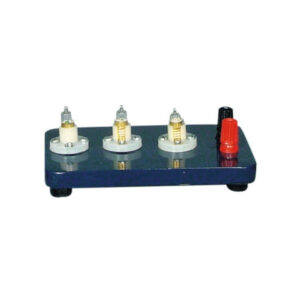
The lamp-holders are connected in parallel.
Supplied with three lamps 3.5 V 0.25 A, M.E.S.
For use with a large motor/generator and a lamp unit to demonstrate the conversion of electrical energy to kinetic energy and then back again.
Comprising an iron flywheel, mounted in cast brackets with bearings.
The shaft has an aluminium 'V' pulley for driving with the spring belt supplied.
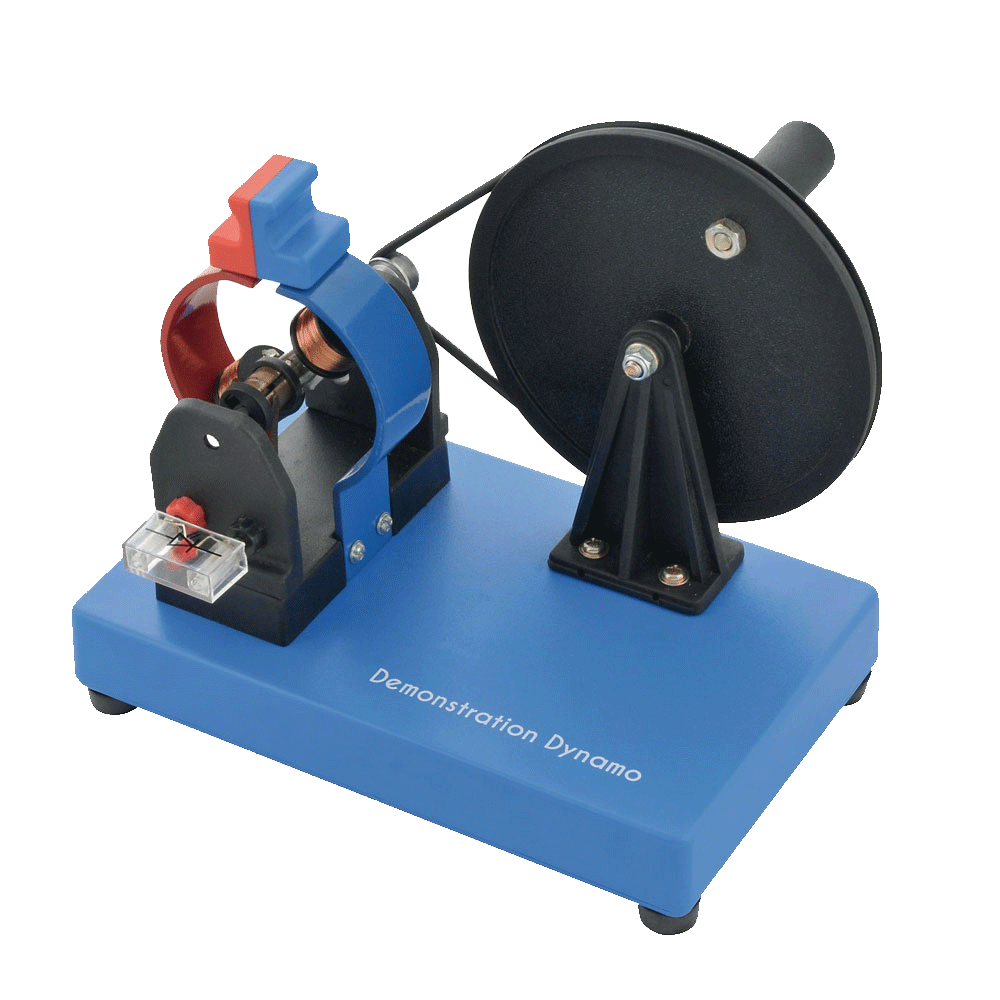
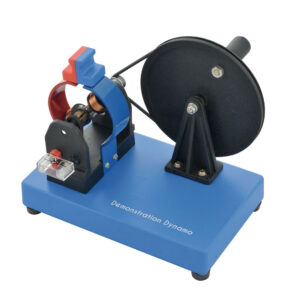
This model uses the same basic assembly as the motor, but is mounted on a baseplate 230 x 90 mm approx.
which also carries a hand-drive pulley 120mm.
diameter coupled to the smaller dynamo pulley by a rubber belt to give a step-up ration.
Electrical output is via a pair of 4mm sockets.
The model may also be used as a motor on a 6-8 V D.C. supply.
A model of the simplest form of D.C. electric motor, having 2-pole armature wound with enamelled copper wire and a permanent magnetic field provided by a removable bar magnet.
A disc-type commutator is incorporated and external connection to the phosphor-bronze bushes is by means of a pair of 4 mm. sockets.
The motor will operates on 6-8 Volts D.C.
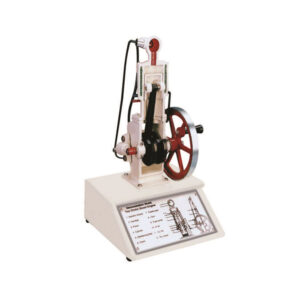
A model of two-stroke diesel engine made in aluminium alloy and gun metal.
Ignition is shown by means of a miniature bulb. Fuel supply is also sectioned.
With hand crank, provided for manual operation.
Mounted on base.
























Reviews
There are no reviews yet.