To show the forces which can be exerted during thermal expansion or contraction.
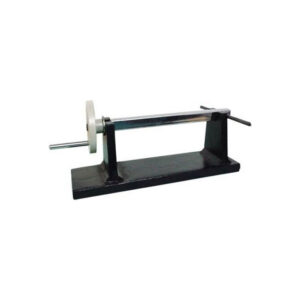
Comprising a heavy cast iron frame 340x120x100mm with slotted end pillars to carry a stout iron bar.
The bar is threaded at one end for a large tensioning nut and has holes at the other end to accommodate the cast iron breaking bars.
Supplied complete with ten breaking bars.
Determination of charge on a electron by measuring a known distance on the basis of number of times of fall under gravity and of rise in uniform vertical electrostatic field in a series of charged oil drops.
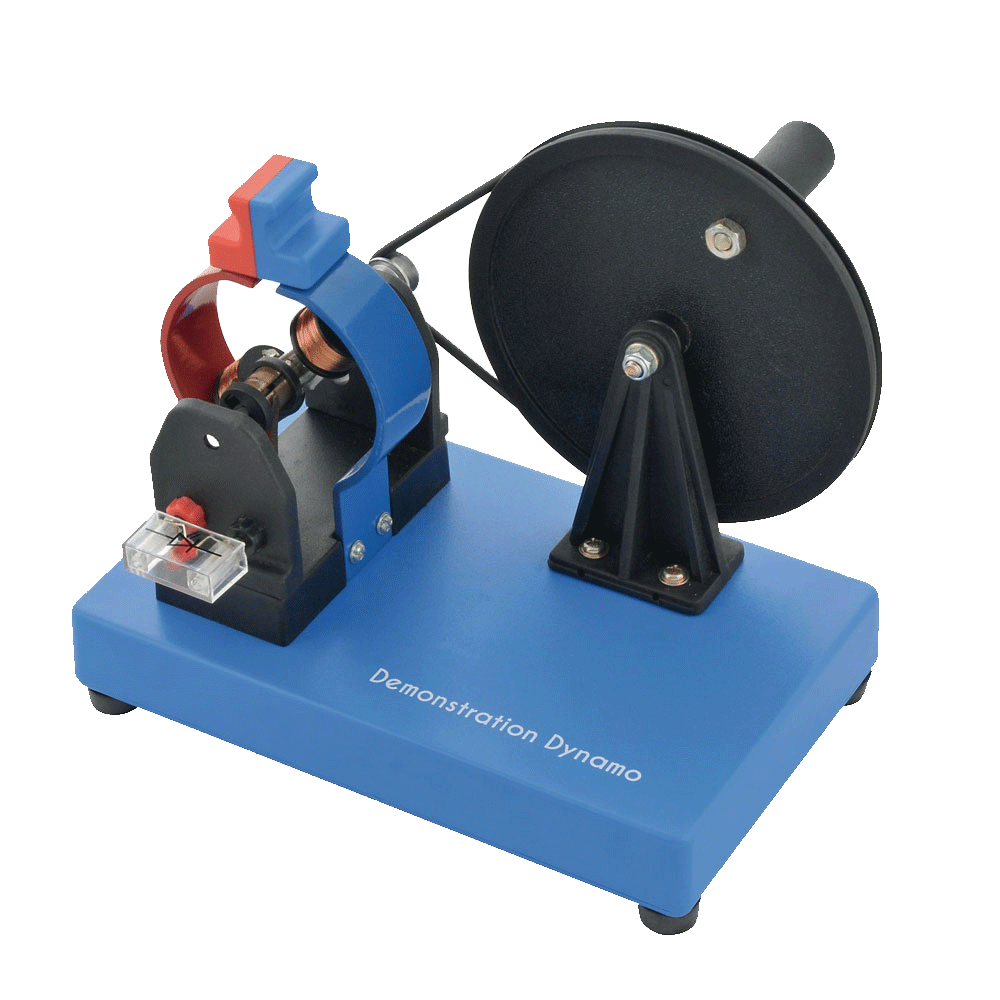
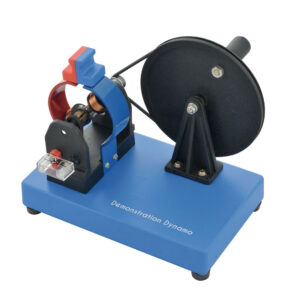
This model uses the same basic assembly as the motor, but is mounted on a baseplate 230 x 90 mm approx.
which also carries a hand-drive pulley 120mm.
diameter coupled to the smaller dynamo pulley by a rubber belt to give a step-up ration.
Electrical output is via a pair of 4mm sockets.
The model may also be used as a motor on a 6-8 V D.C. supply.
For use with motor/generator to give an indication of their output when used as dynamos.
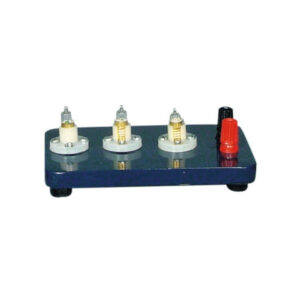
The lamp-holders are connected in parallel.
Supplied with three lamps 3.5 V 0.25 A, M.E.S.
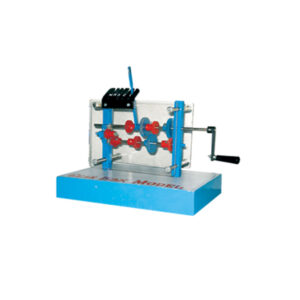
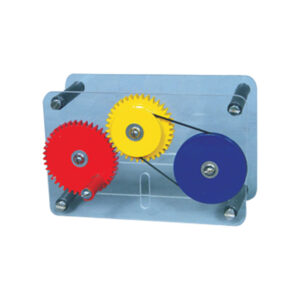
Highly useful for demonstrating the most fundamental and frequently used mechanism.
Very useful for engineering students.
All the components are made of high degree of precision.
These modules are assembled on transparent perspex sheets to facilitate teaching.
Easy to assemble or disassemble.
Operation of a commercial steam engine is well illustrated with this working model.
The extra large size unit is provided with a horizontal boiler with a whistle, safety valve, steam gauge, on metal base.
Operates on 220V A.C. 50 Hz.
To show conversion of mechanical energy into electrical energy.
Turbine with transparent cover, inlet and outlet tubes, directly connected to a dynamo. Fitted on base.





















Reviews
There are no reviews yet.